Tuesday, August 6, 2013

Can water dragons actually run on water?

Today's guest poster is Dr Christofer Clemente. After postdoctoral stints at Cambridge and Harvard, Chris obtained an ARC DECRA and joined the Wilson lab at UQ. You can keep up with Chris's adventures on his science blog, Biomechanics Downunder.

I have long been impressed with the ability of the South American Basilisk lizard to run on water. There are plenty of videos of it on youtube, for example a short one here. 


It's pretty amazing. Looking at this video alone shows 2 important aspects of its locomotion: 
  1. it's able to lift the whole body out of the water, and 
  2. it's able to do so for quite long distances (around 10-15m). 

Some lizards' ability to run on water has been documented quite well by a series of papers by a group at Harvard University, particularly Tonia Hsieh. They've done some great work, including describing how smaller lizards are better able to support their body weight than are larger lizards, modelling 3D forces and recording 3D kinematics of the lizards' stride. Below is a gif showing some of the detailed kinematics of the lizard stride from George Lauders lab webpage. 


(NOTE: just click on the gifs if they are not running)

One other important point reported in these papers, based on the description given in Hsieh (2003), is it seems the lizards' kinematics change when running on water, such that the limb moves behind the hip, rather than being both in front and behind the hip.   

This is shown quite well in the gif above. So given this information on how Basilisk runs on water, we can then ask the question,  
Can the water dragon (Intellagama lesueurii) also run on water? 

I was led to believe it may be able to from two dominate and convincing lines of logic. 
  1. they are water dragons! - it might behoove them to be able to do so and 
  2. I heard reports of the juvenile lizard being observed doing so from a fellow researcher. 

So I modified the lizard racetrack which I have here at the University of Queensland, by placing a short, water-filled aquarium across the water dragons' path which they must cross to get to the other side. Then I sat back and filmed them using the fastec high speed camera system. And this is a typical (read: absolutely best) result below


Well the first thing I noticed is that they are no basilisk lizards. The body is not held out of the water and progress is significantly slowed. The first step seems hardly effective at all, and the second step is much deeper, and seems like a breaking step, with the foot held flat. However, the following step seem to have some similarity to those of the basilisk. From steps 3 onwards, the foot does not appear to be pushed as far forward, and much of the stroke seems to be posterior of the hip, as in basilisk. Secondly the trapped air bubbles on the foot are interesting, and these are also observed for basilisk, where they are thought to be the result of tiny fringes along the toes of the south american lizard. Such fringes however, are not obvious in the water dragons. Below is a snapshot of the bubble being dragged down on the trailing edge of the foot. 


So I'm unsure what to make of this all. It does look like they are capable of some run/swim locomotion, but it certainly falls short of the amazing prowess of the basilisk.

Here are some less impressive runs. Though notice that the right hind foot is actually brought out of the water - suggesting they could be using surface effects to give more downward force. 


And this one below shows a similar stroke. 


So that's as far as I've got. Let me know whether you think it is sufficiently interesting to warrant detailed kinematic analysis, or whether you think water dragons are just a little impaired when it comes to running on water. 

Finally, I leave you with what happens after several trials and the dragons know the water is coming up. It led me to believe, that for water dragons, they sure do not like water! 


Thursday, August 1, 2013

The boldest gecko: personality in a reptile

Today on the blog we're happy to have former Wilson Honour's student, Rebecca Wheatley, who describes her thesis work on gecko personality. Rebecca's currently working as a research associate in the Wilson lab, and plans to start a PhD next year. You can find out more about Rebecca on her science blog, The Adventures of the Integrative Ecologist.

Animal behaviour is a big field - and it's constantly expanding as research reveals gaps in our understanding of why animals do the things they do. One topic in animal behaviour that holds a great deal of interest for me is that of animal personality. This is a relatively new concept and, frankly, it's a little bit controversial. 

The word "personality" conjures up a variety of mental images, most of which pertain to one animal in particular: us. It goes without saying that people have different personalities; we experience it every day. But do other animals have personalities as well?

Great tit (Parus major), beadlet sea anemone (Actinia equina) and pumpkinseed sunfish (Lepomis gibbosus); three species that display animal personality, from very different groups. Image source: Wikimedia commons.

In animal behaviour, the term "personality" is defined as consistent differences in behaviour displayed by individuals. An example of a personality trait is how an individual responds to a threatening situation, termed boldness or shyness. Bold individuals are undaunted by threatening situations and will approach the stimulus, while shy individuals will stay away or hide.

There are heaps of different personality traits that have been studied, including boldness, exploratory behaviour and aggression, amongst many others. Individuals' "personalities" are thought to range along a proactive-reactive continuum, where proactive individuals are aggressive and bold while reactive individuals are more passive and shy (sound familiar? It's not unlike a simplified version of the extroverted/introverted behaviour displayed by people).

There's growing evidence that "personality" is present within many groups of animals. Despite this, we don't really know much about what determines an animal's place along the proactive-reactive continuum or why this variation exists.

My study species: the Asian house gecko (Hemidactylus frenatus). Image credit: Wikimedia Commons (1 & 3) and Rebecca Wheatley (2).

During my honours project, I investigated "personality" in male Asian house geckos (Hemidactylus frenatus). I measured the anti-predator behaviour (a proxy for boldness) of 100 geckos by filming each gecko for one hour and then by calculating the proportion of time it spent inside the shelter in its terraruim. 

Each gecko was measured under three different treatments:
  1. "empty terrarium": where nothing (aside from the shelter) was added to the terrarium, to give me a measure of each gecko’s normal amount of anti-predator behaviour
  2. "terrarium with novel object": where I added a novel object to the terrarium, to see what happened to their anti-predator behaviour when something new was added to the environment
  3. "terrarium with threatening stimulus": where I added a threatening stimulus, to see how their anti-predator behaviour changed when something scary was added to their environment

I found that different individuals reacted to the treatments in different ways, but the overall trend looked like this:


We can see that when a novel object was added to the environment, the geckos' anti-predator behaviour generally decreased when compared to their standard level of anti-predator behaviour. This might be because they wanted to check out the new object to make sure it wasn't food or some other valuable resource. 

However, when I added a threatening stimulus, their anti-predator behaviour jumped back up again to around the same as its standard level. So it seems that the threatening stimulus effectively cancelled out the novel object effect.

How do we know if these behaviours constitute as "personality"? Well, I found that while different individuals displayed consistent anti-predator behaviour within treatments, they also responded to the treatments in different ways. Some displayed more anti-predator behaviour when the environment was altered (were "shyer"), while others displayed less (were "bolder").  Therefore, from our definition, we can see that their anti-predator behaviour is a personality trait: they display consistent differences in behaviour that are context-specific.

Checking on my gecko housing set-up. Image credit: Amanda Niehaus.

But why do individuals have different personalities? Previous research has found that a few things can be associated with an animals' boldness or shyness. A large body mass is often associated with a bold personality, which is probably because heavier individuals are usually larger and more likely to win in a fight (so they have a good reason to be bold). Similarly, individuals with a hard bite force, a strong claw pinch or any other performance trait which would give them an advantage in a contest are usually bolder as well.  

The possession of traits that might make it easier for them to escape from a predator in a pinch, like fast running speed, have also been associated with boldness. In addition, resting (or "standard" for reptiles) metabolic rate has been linked to animal personality; it's thought that bolder, more aggressive individuals need a higher metabolic rate to keep up with their energetic demands.

I investigated how some of these traits interact to effect boldness in my geckos. I measured each gecko's mass, standard metabolic rate, maximum running speed and maximum bite force and analysed their interactive effects on anti-predator behaviour. Contrary to what I expected (and to what the literature would lead us to predict), I found that none of these traits affected anti-predator behaviour. This could be due to a few different things: one possibility is that boldness and shyness in Asian house geckos has a hormonal basis. It could also be that "personality" in geckos develops based on experiences rather than any specific physiological or performance trait. To discover the answer to this question, further research into the interactive effects of such traits on personality needs to be done.

One of my geckos in his metabolic chamber. I did all my metabolic tests during the day (when they are least active, being nocturnal animals) so I could get an accurate estimate of their resting (standard) metabolic rate. Image credit: Amanda Niehaus.


Anyway, why does it all matter – why does "personality" even exist? The fact is there are costs and benefits to being both proactive and reactive. Proactive individuals are bolder and more aggressive, so they are usually better at holding territories and getting laid – but they're also a lot more conspicuous to predators, so they tend to "live hard, die young". Reactive individuals, on the other hand, might not have the best real estate or as many mates at any given time, but their shy behaviour means they usually live longer. So, if we imagine an ecosystem where predation is low, it's better to be proactive and reap the benefits without the risk of being eaten. But if the ecosystem changes (for example, a bunch of predators move into the neighbourhood) and all the proactive guys die off – who is left? This is the most popular theory as to why different personalities exist; so that if conditions change quickly, some individuals survive and the population continues.

Although extremely interesting, these personality experiments were only one small aspect of my honours project, which aimed to answer questions about fighting ability (resource-holding potential) and fighting strategies. More on that later!

- by Rebecca Wheatley

Bit of a teaser for the rest of my project. Image credit: Amanda Niehaus.

Saturday, November 3, 2012

What Determines Gecko Fighting Performance | An Honours Project by Rebecca Wheatley

This is Rebecca. She just submitted her Honours thesis, and is probably chilling with a vodka lemonade on a beach somewhere. | Or else she's wishing she was. |


A couple months ago, I asked Bec to describe her thesis - and to show me the experiments she had running. Here's what she said:
My research is using Asian house geckos as a model to answer questions about how morphology, performance, metabolic rate and personality interact to affect fighting ability in animals.

Gecko housing project

Rebecca's work is exciting because few studies have evaluated how morphology (or body size | shape), physiology, and personality work together to determine animal performance.

And can animals really have personalities? Of course, but not like you and I do. In the non-human world, personality can refer to repeatable differences in behaviour among individuals. For example, some individuals consistently tend to be shy, and others tend to be bold. Boldness | shyness is important for animals, as it can determine the likelihood of obtaining food or mates, or getting captured by predators.

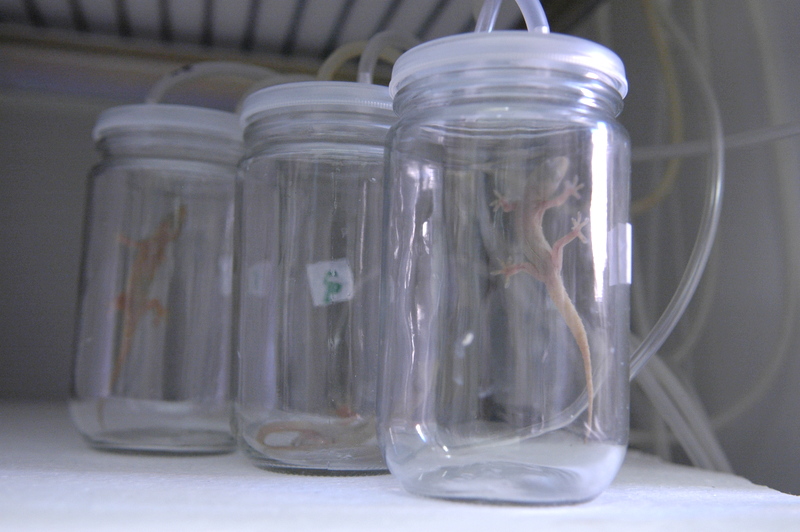
When I caught up with Rebecca, she was measuring geckos' metabolism in purpose-designed jars, which were hooked up to specialised equipment that measures oxygen consumption. Oxygen consumption is one way that scientists assess metabolic rate in animals in the lab.

collecting data on gecko metabolism

Rebecca was also video recording interactions between randomised pairs of geckos. Asian house geckos are aggressive little lizards, and will sort out dominance via displays of their open mouths, biting, and | or chasing. In her thesis, Rebecca looked at which animals were likely to be dominant, and whether that depended on their metabolism, morphology, and | or personality. 

collecting data on gecko fighting

And what did she find? The oversimplified version is that bite force, body mass, and running speed were most important in determining gecko dominance. Big, fast, hard-biting geckos were likely to be winners. The surprising thing was that metabolism and boldness didn't seem related to fighting performance.

There's a lot more to Rebecca's research: she used all the information she collected on morphology | physiology | behaviour to test important ecological theories about how individuals should interact (known as game theories). But we'll talk more about that another time - we don't want to give away everything just yet.

Thank you Rebecca, for taking the time to share your honours work with us, and for being such a wonderful labmate!

written and photographed by Amanda Niehaus, PhD

Wednesday, September 19, 2012

Welcome to Our Newest PhD Students


The lab is getting bigger! Andrew Hunter {Chopper} and Ami Fadhillah Amir have just joined the lab to do their PhDs - Chopper on performance and Ami on conservation. Ami acquired a prestigious Malaysian scholarship for her work, so we don't know for sure if the following is applicable for her ... but for Chopper, at least, post-doc Sean Fitzgibbon put together a financial plan for his upcoming years of servitude:

"Chop, I have just looked at the conditions of your award and spoken with your accountant.

We offer the following:
Stipend $23,728 per annum (Tax-free) = $461/wk

Committed expenditure:
Mortgage $380/wk remainder $81
Utilities $28/wk remainder $53
Football subs $17/wk remainder $36
Groceries $23/wk remainder $13
Home brew $8/wk remainder $5

We suggest that you set-up a trust savings account to invest your weekly surplus income of $5. Based on my calculations, after your PhD you should be able to live off your savings (and interest - based conservatively on 6.2%) for approx. 2.1 days. This should really take the heat off when you are searching for a job post-hand-in

Welcome to the familia! Let me know if we can be of further assistance*." - S.F.

*this post is not meant to replace real financial planning and new PhD students should always consult a bona fide accountant for advice on saving vs. spending their income. If they can afford one.

Tuesday, September 11, 2012

Fieldwork, Groote Eylandt, NT

It was only a week ago we got back from Groote Eylandt. What a special place. Wild, and raw, and special. An island of contrasts, between a traditional culture and a modern mining industry. An island with a lot of crocodiles.

the GEMCO manganese mine

It was my first trip up, and Nelle came along. We met the Rangers and friends and family and Gavin and Kerry and the rest of the team and Alex-from-Stanford. We drank tea on the deck at the Ranger station, and packed up everything {but petrol} for a quoll-catching venture to the east side of the island. {Former labmate} Billy was appointed Ranger Coordinator. We learned our first Anindilyakwan words. We entertained Nelle, and learned the value of ABC for Kids downloads {and PhD students}.

On the deck with Jennifer and her niece; with Chopper; with MacBook Pro

We drove east to Umbakumba then headed into the bush on sandy tracks. We set up tents on top of a berm, feeling {relatively} safe from water-borne crocs and collected firewood from the beach. We watched a heavy moon pull itself up into the sky.

Picnic Beach, Groote Eylandt

Under Jaime's guidance, we set out traps for quolls, hoping to catch at least a few to obtain measurements and hair samples.

Jaime and Eddie set out, bait, and mark quoll traps

We caught 4. Plus a few bandicoots. It was good enough for Jaime to get her samples, and good enough for me - these were the first wild quolls I'd seen.

A quoll curled up in its very own, custom-made pillowcase

We were almost as successful catching fish ... the ocean here teems with them {apparently} but we didn't have much luck. Three fish only made it into our bellies.

That's ok. We had plenty of patience ... 
and potatoes. 

fishing for dinner

- written by Amanda Niehaus

Tuesday, September 4, 2012

Groote Eylandt, August 2012

Leaving Darwin, the propellers outside hummed loudly (reassuringly). We pressed our noses to the windows, looked out on the wild top coast of Australia. The fires lit by thousands of years of tradition. And then, we were there. Over the mines, into the red dirt.

Groote Eylandt.

Wednesday, May 16, 2012

Crabs will fake it to avoid a fight

Crabs will fake it to avoid a fight, research finds

Dr Robbie Wilson, Head of the Performance Lab at UQ, where this study was conducted, said the research identified more than just some crabby behaviour.

“This study is important because it reveals the general principles behind how liars and cheats are controlled and encouraged in nature.

“Whether it's a soccer player diving to fool a referee or a crab trying to intimidate a rival with weak claws, our lab has shown that individuals cheat more when their deception is likely to go undetected,” Dr Wilson said.

Ms Candice Bywater who is finishing her PhD on fiddler crabs, said that she found that more males bluff their way through fights when they are less likely to get caught.

photo by D. Hancox

“When there are lots of crabs living in one area, there is lots of competition for resources like females and food. High competition means there is a greater chance of males having to fight each other to win resources compared to when there are not many crabs about. Those crabs might not have to fight at all,” Ms Bywater said.

“Crabs that have strong claws will generally win fights. Producing large and strong claws is important to their survival.

“Where crabs are likely to have to fight a lot, the crabs are producing large, strong, reliable claws. We found that when there are not many other male crabs in a population (low competition), males produce large but relatively weak claws (unreliable), as they don't have to fight as often and ultimately because can get away with it."

In nature, signals may be behavioural, as in growling or posturing, but are often structural, including the antlers of a deer, and the enlarged fore-claw of many crustaceans.

A male that overstates his quality could improve his ability to gain food or mates, but surprisingly, most signals are honest reflections of a male's prowess.

Media contact: Dr Robbie Wilson, School of Biological Sciences, E: r.wilson@uq.edu.au, mobile: 0458 204 962; Performance Lab: http://www.wilsonperformancelab.com/ 

Bywater, C & Wilson RS. 2012. Is honesty the best policy? Testing signal reliability in fiddler crabs when receiver-dependent costs are high. Functional Ecology.

David GK, Condon CK, Bywater CL, Ortiz-Barrientos D & Wilson RS. 2011. Receivers limit the prevalence of deception in humans: Evidence from diving behaviour in humans. PLoS ONE 6(10): e26017 http://www.plosone.org/article/info%3Adoi%2F10.1371%2Fjournal.pone.0026017

Written by UQ Media

Saturday, March 17, 2012

How to fight dirty

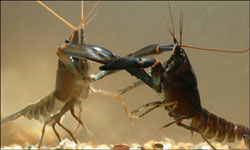
If you're a crayfish, your best bet is probably to grow an intimidatingly-large claw ...
but pack the muscle (i.e. punch) into the other claw.


Many animals - like crayfish - signal their fighting prowess by displaying specialized limbs, musculature, or weaponry to others. In signaling, bigger is often better; but in a fight, rivals could gain advantage by concealing their real strength in less conspicuous limbs.  

Cryptic asymmetry occurs when differences in limb strength are unrelated to differences in limb size, and was previously considered only in primates; however, we found asymmetric strength in males of the slender crayfish, which use their claws in display and combat. 

In a paper just published in Biology Letters, Robbie and collaborator Mike Angilletta suggest that asymmetric strength could be used to confuse rivals and influence the outcome of fights.

(look over here ... look over here ... )
 WHAM.

Monday, February 27, 2012

Big News at the Moment - Feb 2012

1. Robbie got his 69th publication, and for some reason thought that was funny.

2. Candice returned from the US, jet-lagged and culture-shocked. We've missed her.

3. Billy's still ... somewhere?

4. Jaime's officially started her PhD, and taken up the last desk in the Fun Zone.

5. Another of Candice's PhD papers just got accepted for publication! This one's:
Bywater, C & Wilson RS. 2012. Is honesty the best policy? Testing signal reliability in fiddler crabs when receiver-dependent costs are high. Functional Ecology (in press Feb 2012)

6.  Robbie decided it was time to get married. To me.

And that's February, 2012!

Monday, February 20, 2012

The Scent of a Predator (Well, Kind of)

The following article is adapted from a talk presented by Jaime Heiniger at SICB 2012, along with coauthors Billy Van Uitregt and Robbie Wilson. The original talk was called: "Fine tuning anti-predator responses: are the costs of inducible predator defences proportional to the magnitude of the responses?"

***

For amphibians, it's a mad, mad world. And - importantly - an unpredictable one. Natal pools might contain predators, or not; competitors, or not; food, or not; and conditions can change every day. As a result of all this unpredictability, many amphibians can alter their appearance and behaviour in ways that increase their likelihood of survival. But these defensive strategies usually come at a cost - slower growth, higher metabolic requirements, and smaller size at maturation are just a few common outcomes.

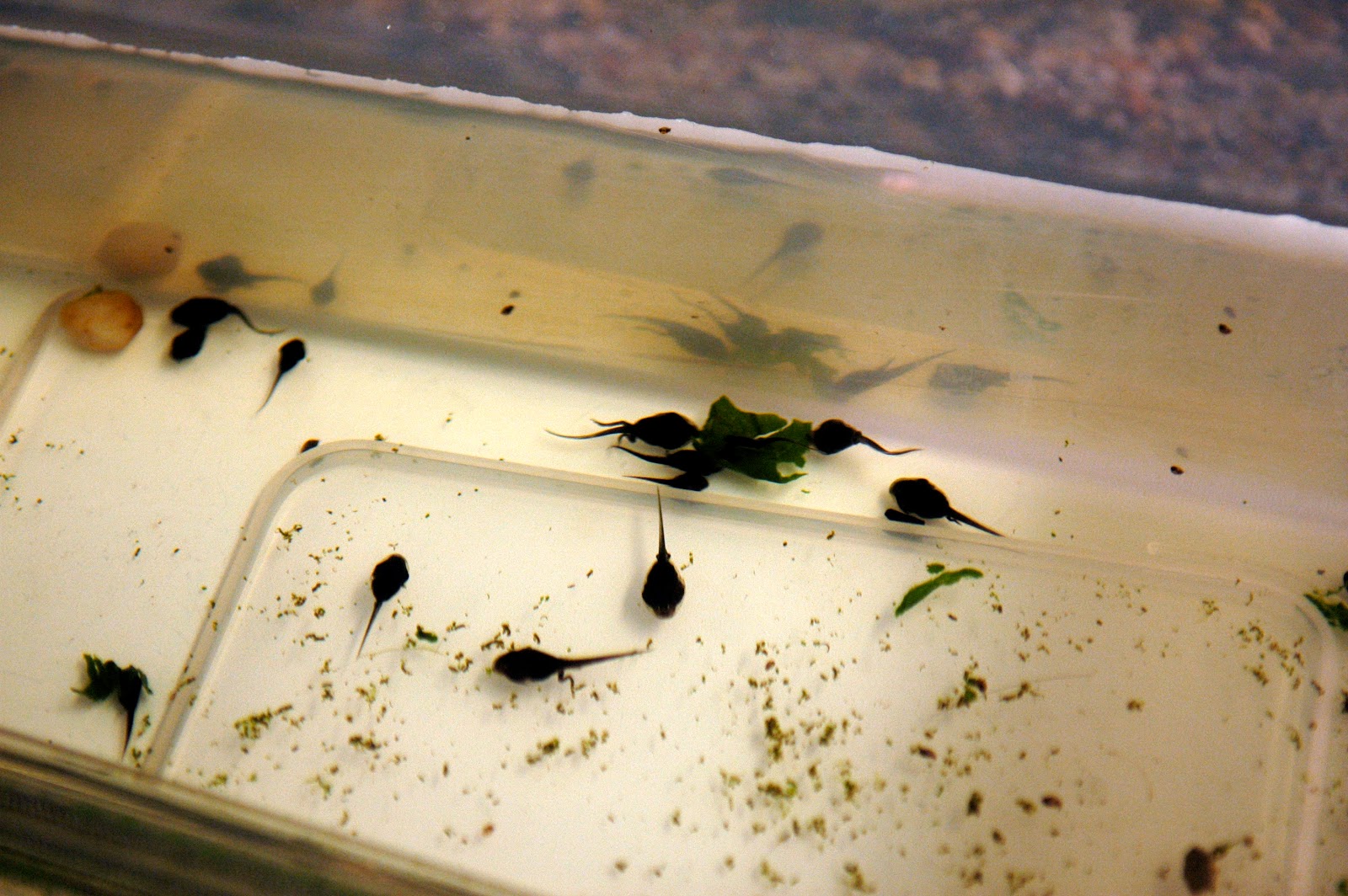
toadlets in the lab

To maximise the benefits and minimise the costs associated with predator defense, it's predicted that the magnitude of the defensive response should reflect the magnitude of the threat. Thus, more threat = more phenotypic change; and less threat = less phenotypic change. This is known as the threat-sensitive predator avoidance hypothesis (TSPAH), and although it's known that prey can fine-tune their responses to the degree of predation risk, it's unclear if the magnitude of threat-sensitive defensive responses relate to their associated costs.

{Jaime} tested this idea by examining the effects of increases in perceived predation risk on the expression of defences and their associated costs in larvae of the toad, Bufo marinus. She reared tadpoles in varying concentrations of predation cue* and quantified their growth, morphology and development, as well as metamorphic size, locomotor performance and oxygen consumption.

*for those curious, predation cue is actually water from around deceased tadpoles. Tadpoles are sensitive to the smell of their dead mates. (Aren't we all?)

taddies in the lab

{Jaime} found that tadpoles responded to increases in perceived predation risk by gradually decreasing their activity.

As a consequence of their more-sedentary lifestyle, individuals metamorphosed later, smaller and with reduced endurance. Toads that emerged from the different treatments didn't vary in maximum jumping distance but those from 'high predation' treatments metamorphosed with longer relative hind limbs - meaning they could jump farther for their body size.

jaime's metamorph habitats

 These are interesting results, because they show that
a) toads produce defenses that are proportional to the perceived threat
b) defensive behaviour is costly
c) the costs are in proportion to the amount of defense
d) but phenotypes produced in response to predation threat may aid the individual.

Cool stuff, Jaime!

Wednesday, February 8, 2012

Why Be Fake? Because Honesty is Too Expensive ...

In earlier posts, we've talked about the life of a crab ... and about the predisposition for some crabs to fake how strong they are. At SICB in January, Candice presented a talk detailing why exactly it pays to be weak.


image by Dan Hancox
Here's my recap on Candice's talk ...
Crustaceans are violent types, posturing and fighting for territories, mating partners, and resources. Because claws are such excellent weapons, fights are often decided by the individuals merely checking each others' claws out. Bigger claws = dominance. This ameliorates the risks associated with claw-battle, while still deciding dominance.


But Candice has found that the size of the claw is not always indicative of its strength - namely, some individuals are fakers. You see, claw muscles - which are used to clamp and tear in a fight situation - are hidden inside the chitinous claw. So a big-clawed crustacean might just lack big muscles underneath, meaning it's more likely to lose if the interaction escalates into a fight.

So why wouldn't a crustacean just grow the muscle? This is what Candice wondered. She noticed that crabs with re-generated claws tended to have wimpy claws, relative to their claw size. So, she measured the energy needed to maintain claw muscles in fiddler crabs with strong, original claws as well as crabs with weak, regenerated claws.


Candice believes that dishonesty in fiddler crabs is related to metabolic costs - namely, how much energy is required to keep that muscle active. Crabs with strong, original claws spent ~22% of their metabolic energy budget on their claw muscle - pretty close to the amount of metabolic energy humans use to support our large glucose-hungry brains.

In contrast, crabs with weak, re-generated claws used only ~12% of their daily energy on claw muscle.

That constitutes a massive energetic savings for fakers, unless they get caught ...

Monday, February 6, 2012

CB in DC

At this precise moment, Candice is working at the Natural History Museum in Washington, D.C. - measuring crustacean claws as part of a study for her PhD.


Or, she might be sleeping. (I can never get those time-differences right ... )

At any rate, this is her lovely little brownstone ...


She's even famous now, in a "The Lost Symbol" kind of way, toiling away in the crustacean collections in Pod 5* at the Museum Support Centre (MSC), a high-security warehouse in the sketchy part of town.

*The same section of the warehouse featured in Dan Brown's book ... in case you haven't read it yet.
 

And how does Candice spend her days in DC? She's on the bus at 7:30, heading to the Natural History Museum in downtown DC, where she catches the shuttle to the warehouse facility where the crustacean collections are housed.


In to her little lab in the wet collections rooms by 8:30, she starts taking photos of crab claws and measuring the sizes of the shell and legs - for different specimens and different species. It sounds like quick work, but given she has to take 3 measurements of each crab leg (and each crab has 8 measurable legs), she may just be there ... all year.


Not really. But I'm sure that's how she feels sometimes. 10-15 minutes per crab x a warehouse full of crabs = significant porters needed at the end of the day.


Candice measures claws on her own, but has lunch with the other 10-15 researchers who work at the warehouse measuring, cataloging and sorting other types of invertebrates. They all chat and sometimes have science talks, so it's been a great way to meet everyone else.

Then it's back home again, to forget about claws for 12 hours or so.


And why is she doing all this? Candice is looking for tradeoffs between claw size and other morphology among different crustacean species - compensatory mechanisms (like we just learned about with geckoes). We'll talk more about the science after she gets back.

(all the pictures in this post were provided by Candice. Thanks!)

Thursday, February 2, 2012

Trade-offs in Gecko Design

Sounds glam, right? Gecko design?

At the 2012 SICB in Charleston, Skye presented research that shows how traits that improve bite force in geckos have negative impacts on the gecko's sprint speed. Meaning that males who are better fighters might also be less adept at escaping predators ...

Costly design indeed.


Let's learn more by having a look at Skye's abstract, with {comments in brackets from me}.


Trade-offs and compensatory traits: bite force and sprint speed pose conflicting demands on the design of male geckos (Hemidactylus frenatus)
by Skye Cameron, Melissa Wynn and Robbie Wilson

The evolution of exaggerated ornaments and armaments is driven by the benefits accrued to reproductive success and by the costs imposed on viability. {This means that} when traits are required to perform multiple functions that are important to both reproduction and viability, trade-offs can result in a compromised phenotype.

{Imagine, for example, a species of bird in which females are more likely to mate with males that have larger tails; but males with larger tails are more likely to be captured by predators. Both reproductive potential and survival are important to the male - so evolutionarily, the bird may end up compromising on tail length to make sure he both reproduces and survives.}

image

{Intuitively, we expect that exaggerated male traits (like super-long tails) would decrease locomotor capacity, resulting in lower survival rates due to predation.} Despite only mixed empirical support for such locomotor costs, recent studies suggest these costs may be masked as a result of the evolution of compensatory mechanisms that offset any detrimental effects.

{What are compensatory mechanisms? Imagine if that bird with the long tail-feathers developed longer wings, that enhanced its flying abilities. It might offset some of the survival costs of the long tail.}

In this study, {Skye} provides a comprehensive assessment of the importance of potential locomotor costs that are associated with improved male-male competitive ability by simultaneously testing for locomotor trade-offs and compensatory mechanisms. For males of the Asian house gecko (Hemidactylus frenatus), both fighting capacity and escape performance are likely to place conflicting demands on an individual’s phenotype.

image
Males that are highly territorial and aggressive are more likely to require greater investment in jaw size/strength in order to compete with rival males; {Skye} found that males with larger heads had stronger bites and showed greater prey-capture and fighting capacity. This performance trade-off was amplified for male geckoes with larger heads when {they were} sprinting up inclines.

image
{So, what does this mean? Geckoes with large heads are better at fighting and better at capturing prey, but may be worse at evading predators themselves. A compensatory mechanism would be something - like longer legs - that would enhance their ability to avoid predation.} {However, Skye} found little evidence for compensatory mechanisms that off-set the functional trade-off between bite force and sprint speed.

Ongoing work in this area includes testing the survival of male geckoes with different sized heads in controlled-but-natural conditions.