Friday, May 30, 2014

From the field: Studying endangered northern quolls on Groote Eylandt

- by Rebecca Wheatley

It's a new year, which means there's new research to be done as I delve into my PhD. But before I start writing about that, I want to write about a somewhat related experience I was lucky enough to have last year.

In August/September, I got to join my labmates Ami, Jaime and Gwen up on Groote Eylandt, which is a large island off the coast of the Northern Territory owned and run by the Anindilyakwa people. The reason:
to help them out with their research on the endangered Northern Quoll (Dasyurus hallucatus).

Catwoman, a pretty little female Northern Quoll (Dasyurus hallucatus). 

Now, if you’ve ever been to Australia, you probably have heard the story of the Cane Toad (Rhinella marina) – even if it’s just via one of the many delightful novelty souvenirs available in Australian tourist shops.

A classy addition to any accessory collection. Image credit: Wikimedia Commons. 

The cane toad is an extremely successful invasive species that was introduced into Australia in 1935 to eat a beetle that was negatively affecting the cane industry (which it didn’t), and since then it has spread down the East coast and across the Northern Territory, and is slowly making its way down the West coast as well. One of the reasons Groote Eylandt is so amazing is because it is one of the few areas up North that has remained cane toad-free. Because of this exclusion, it is the last stronghold population of the endangered Northern Quoll, whose numbers have been decimated via their predation on this toxic species. This makes Groote an ideal location to study the quoll in its natural habitat, as numbers are high enough for recapture studies to generate useful amounts of data.

A magical sunset in the bush next to the highway to Umbakumba.

I was on Groote Eylandt for 5 weeks helping Ami with data collection for her PhD project. As well as stunning landscapes and amazing native animals, Groote Eylandt is also home to a large manganese mine. All animals need some amount of manganese to function, but like any heavy metal it can be toxic in high concentrations. For her PhD, Ami is looking at how quolls from different parts of the island (that have been exposed to different amounts of manganese) perform in motor control and cognitive function tests. We are lucky enough to have access to laboratory facilities at the Anindilyakwa Land and Sea Ranger Station, where we get to work with the Rangers to figure out how to do our research in a way that is compatible with indigenous culture.

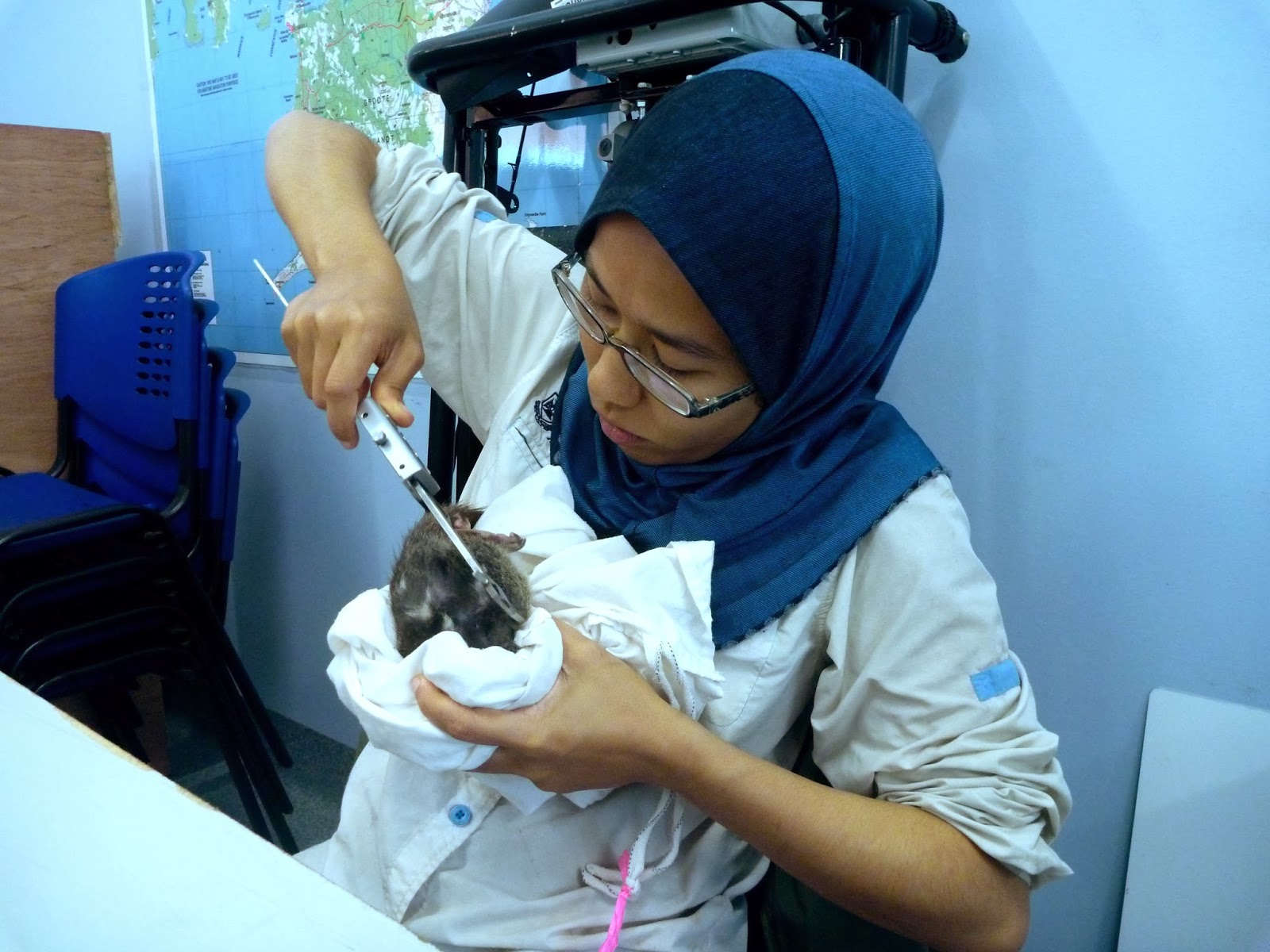
Ami measuring one of our little darlings. 

We went out every night and set 30-60 traps in one of our three trapping areas various distances from the manganese mine, which we then checked first thing the next morning. If we were lucky, we’d see white spots and hear some angry growling – otherwise it was rather likely that we’d caught one of the other marsupials that populate the area. We then transported our precious bundles back to the lab at the Anindilyakwa Ranger Station where we sexed them, weighed them, took various morphological measures and a hair sample (to get their internal manganese concentration from) and pit- and ear-tagged them.

Alfred, a feisty (and adorable) little male. 

Lastly, we’d gather information on their level of motor control. I won’t give away too many details, but we basically assessed their performance at various speeds and analysed how many mistakes they made depending on the difficulty of the task and the speed at which they performed it. We would expect that as speed and/or “difficulty” of the task increases, the quolls will make more mistakes. The reasons for this are very intuitive and you will probably have observed them in your own life; as you do things faster you have less control over your movements and are more likely to make an error. Similarly, if a task is difficult, you’re more likely to make a mistake than if it’s relatively easy. What Ami wants to know is whether the manganese concentration the quoll has been exposed to enhances this effect – i.e., whether high manganese concentrations affect motor control.

Back to the bush you go. 

Ami also wants to look at whether manganese concentration affects cognitive function in the quolls – but that’s for her to write about! She’ll continue to run these experiments for the next two years, and hopefully get some excellent results. I was very lucky to be involved in helping out with this project, as many of the techniques she used will be helpful in my own PhD.

Having a sniff out of the corner of his bag. 

Although quolls were the main attraction for us, Groote Eylandt has plenty of other amazing qualities that made my trip there one of the most memorable ventures into the field that I’ve ever had. We are extremely privileged to be able to conduct research there, and I learned more about indigenous culture than I ever thought I would. I also saw loads of awesome animals and plants, and got to spend a lot of time in the field – which is definitely one of the best ways to spend it.

A Mertens' Water Monitor (Varanus mertensi) chilling by Milyerrngmurramaja (the "Naked Pools"). These guys are also threatened by ingestion of the cane toads. 
A Striated Pardalote (Pardalotus striatus) that was nesting next to the Anindilyakwa Ranger Station.
A Burton's Legless Lizard (Lialis burtonis) we found while we were setting traps near Alyangula.
A Helmeted Friarbird (Philemon buceroides) next to the highway to Umbakumba. 
I’d like to say a huge thank-you to my lab for this opportunity, but most especially to Ami, Jaime and Gwen for teaching me so many new skills and being the best bush-buddies ever. I’m looking forward to future adventures with the Wilson Performance Lab as I start my PhD on another kind of carnivorous marsupial… the Yellow-footed Antechinus (Antechinus flavipes)!

Sunset on the beach at Ayangkwa ("Tasman Point"). 

All images by Rebecca Wheatley unless otherwise credited.

Tuesday, March 4, 2014

UQ CIEF Grant awarded to the Performance Lab

- by Robbie Wilson

Last week I travelled back to Groote Eylandt to sign off on a collaborative research project with the Anindilyakwa Land Council worth $375,000 over the next two years. This supports an important project and recognizes our strengthening relationship with the people of Groote Eylandt with whom we've been working for the last five years. 

Indigenous dugong painting on Groote Eylandt
 
For our UQ-CIEF grant we'll be exploring the possible toxic effects of manganese from the local mining operations on the wildlife of Groote Eylandt. Groote hosts one of the world’s largest Mn mines - and despite considerable financials rewards for the local community, many locals are becoming increasingly concerned about the long-term impacts of Mn contamination for their environment. The toxic effects of Mn usually manifest in animals by affecting their cognitive and motor function, which places our research group in a unique position to tackle this research.

We'll examine the pattern of Mn accumulation in the local wildlife and then test whether any increased Mn affects motor function in our primary study animal, the northern quoll. This species offers a perfect model system because it is highly abundant across the island – both close and far from the mining operations – and we can easily adapt tests of motor control from protocols used in biomedical studies of rats and mice.

Groote Eylandt field work

Ami (PhD student) and Skye (Researcher) will be the main team members working on this project but, as always, everyone in the lab will contribute to the smooth running of the work. There is never a shortage of volunteers offering help!! We’re all excited about continuing our work with the Indigenous Rangers of Groote Eylandt and we hope they get as much out of our collaboration as we all do. My feeling is that you haven’t graduated as an Australian ecologist (or zoologist) until you’ve wandered through the bush with a real local and seen the land through their eyes. 

Thanks again to the Anindilyakwan people for their on-going trust and acceptance of our research team. We look forward to the season ahead.
Robbie 

I spent a late afternoon wandering rocky landscapes and avoiding crocodiles

Tuesday, September 17, 2013

In Search of Hot Mosquitofish

thermal ecology research Queensland outback
A natural thermal gradient - the hot bores of outback Queensland

- by Robbie Wilson

How do animals adapt to hot temperatures? What allows some animals to do well in hot conditions while others simply, well – die? Seems like a pertinent question when one considers the world is getting hotter. And quickly.

My current ARC Discovery Project poses these very questions. I want to understand the mechanisms of adaptation to warmer temperatures and how this can shape a species' population dynamics and survival. It's not surprising then that my interest was piqued by rumours of an introduced species of freshwater fish (the ubiquitous mosquitofish) that can actually survive in the bath-hot bore drains of western Queensland.

Across the state's west, numerous deep bores tap into the rich underground water sources of the Great Artesian Basin. Water spews out of these pipes from depths of more than 1500m at temperatures in excess of 70°C, flowing into narrow drains and cooling – allowing livestock to persist in an environment that would be otherwise uninhabitable. Fish (well, so the rumours go) inhabit these open drains at year-round temperatures above 30°C and sometimes even greater than 40°C. The possibility of capturing and studying these fish was too tempting to ignore.

RA Skye Cameron + echidna


My RA and lab organising force Skye is used to my crazy, impetuous ideas, and she doesn't even seem surprised when my ideas are offered at stupidly short notice and without any respect for logistics. In this specific case, Skye laughed – and started packing – when I suggested we should head out west in search of some hot fish in just a few days’ time. We would collect some fish from hot bores to study in the lab. It was the prospect of teaming-up with some UQ colleagues that work out near Barcaldine (1200 km north-west of Brisbane) who know the local people, properties and bore-drain locations that lit a fire under my b-hind.

So - it was early on a Monday morning that Skye picked me up half-asleep (me, not her) and we set-off on our adventure with no guarantees of success (let's face it, little chance of success). By lunchtime on Tuesday we reached Barcaldine. We'd avoided suicidal kangaroos and emus playing chicken with every vehicle pelting along the highway, and we rendezvoused with Jeremy (RA) and Billie (Honours) – from my colleague Rod Fensham's lab group – at the local bakery. Incidentally, Rod and Jeremy work on the spring systems of Edgbaston - the site of Australia's most endangered freshwater fish, the red-finned blue-eye (more on this another time).

we had to stop driving at dusk as the emus and kangaroos made the roads dangerous

After the obligatory orientation tour of the town's pubs on Tuesday evening and a sampling (2 kgs) of the local beef (not by Skye), we set off in search of bores on Wednesday morning. It didn't take long before we found them.

The first property we visited had a bore flowing out at 55°C into a tiny, narrow drain. Over the course of 30 m, the water cooled down to temperatures of around 45°C, and as we walked along the drain we spotted our first hot candidates. Little juvenile mosquito fish living at 42.8°C. Holy be-jesus!! This temperature is higher than I thought possible for any mosquito fish to survive in.

It was incredible - fish living in water I found hot to the touch.

mosquitofish were found at temperatures as (naturally) hot as 42.8 degC

Walking along the drain revealed a beautiful temperature gradient that dropped down by around 1°C every 5 meters. When we hit temperatures of around 35°C there was an absolute explosion of fish and the surface rippled with movement. We'd found our hot fish – and in truly staggering numbers. The air temperature was just a little over 20°C – and it was dropping nightly to below 5°C – yet the fish were enjoying balmy water. These fish had found their stable, warm conditions and were clearly loving it.

kangaroos - as far as the eye could see

By the end of the next day, we'd collected mosquitofish from two more sites and were ready to head back to Brisbane with a troop-carrier full of bore water and thermophilic fish. All we had to do was avoid those roos and make it back for my daughter Nelle's birthday party by 11am Saturday (Happy Birthday Princess).

And we did. I was only 30 minutes late to the party …
Robbie

Wednesday, August 21, 2013

The Grand Slam: How Hard Should You Hit?

Today on the blog we're happy to have former Wilson Honour's student, Rebecca Wheatley, who describes her thesis work on gecko personality. Rebecca's currently working as a research associate in the Wilson lab, and plans to start a PhD next year. You can find out more about Rebecca on her science blog, The Adventures of the Integrative Ecologist. 

The trade-off between performance and accuracy is a problem faced by a lot of different animals in a variety of situations. For example, consider a squirrel running along a bare branch to get from one tree to another; the faster it runs, the less time it spends exposed to predators. However, as the squirrel runs faster, it also increases its chances of mis-stepping and falling to its potential doom. 

So, to get the best of both worlds, the squirrel needs to optimise its running speed depending on its chance of slipping (the width of the branch) and the cost of falling off (the height from the ground).

Squirrels know what’s going down (or do they)? Image source: Wikimedia commons.

These sort of performance/accuracy trade-offs are also commonplace in the human world. How fast should you smash out a text message to your supervisor asking him (politely) to email back your latest draft before the number of typos makes the whole thing unintelligible?  In particular, these trade-offs are of a great deal of interest in elite sports. An awesome example of a sport where this trade-off is of utmost importance is in singles tennis. 

Serving hard: Heather Watson, Roger Federer and David Ferrer. Image source: Wikimedia commons.

In tennis, it’s pretty well accepted that if you serve really hard, it’s more difficult for your opponent to return the ball. But the harder you serve, the more likely it is that you’ll miss the service area and fault. So, players will usually belt it out on their first serve, but if they miss the first serve they’ll hedge their bets and serve softer the second time round to make sure they don’t double fault.

A/Prof Robbie Wilson, Dr Chris Brown and I have been testing this idea about performance trade-offs and optimal strategies using data from the men’s singles in the 2013 Australian Open. We’ve found this observation to be generally true: the probability of winning the point increases as the serve speed approaches its maximum, but the probability of faulting increases as well (for most players – some players are really consistent at getting it in regardless of how fast they serve). This was reflected in the frequency of high serve speeds in the first and second serves.

Jérémy Chardy, Andy Murray and Janko Tipsarevic. Image source: Wikimedia commons.

We’ve also constructed an optimality model which predicts the optimal serve speed taking into account the probability of faulting and the cost of a fault. An optimality model is, in essence, a mathematical model where you input the risks and rewards of a specific situation for a given individual, and it will tell you the optimal response for that individual if it wants to both minimise the risks and maximise the rewards. 

Optimality modelling is useful because it allows us to calculate the optimal response of specific individuals to any situation. We are looking at whether their opponent’s world ranking (ability to return a fast serve) and the point they’re going for or defending against (normal, game, set or match) affects their serve speed in relation to their optimum, but more on those results later.

Rafael Nadal, Caroline Wozniacki and Jérémy Chardy. Image source: Wikimedia commons.

We hope that our research can teach us more about how animals optimise their behaviour and physical efforts to improve their chances of successfully performing a given task. Depending on what we find, we might even be able to offer specific recommendations to tennis players wanting to improve their service game – who knows what the future might hold!

Andrew Hunter, a PhD student in our lab, is looking at performance/accuracy trade-offs in soccer. Will the results be similar between an individual and a team sport? We don’t know yet, but it will be interesting to find out.

Novak Djokovic, Agnieszka Radwańska and Venus Williams. Image source: Wikimedia commons.

Tuesday, August 6, 2013

Can water dragons actually run on water?

Today's guest poster is Dr Christofer Clemente. After postdoctoral stints at Cambridge and Harvard, Chris obtained an ARC DECRA and joined the Wilson lab at UQ. You can keep up with Chris's adventures on his science blog, Biomechanics Downunder.

I have long been impressed with the ability of the South American Basilisk lizard to run on water. There are plenty of videos of it on youtube, for example a short one here. 


It's pretty amazing. Looking at this video alone shows 2 important aspects of its locomotion: 
  1. it's able to lift the whole body out of the water, and 
  2. it's able to do so for quite long distances (around 10-15m). 

Some lizards' ability to run on water has been documented quite well by a series of papers by a group at Harvard University, particularly Tonia Hsieh. They've done some great work, including describing how smaller lizards are better able to support their body weight than are larger lizards, modelling 3D forces and recording 3D kinematics of the lizards' stride. Below is a gif showing some of the detailed kinematics of the lizard stride from George Lauders lab webpage. 


(NOTE: just click on the gifs if they are not running)

One other important point reported in these papers, based on the description given in Hsieh (2003), is it seems the lizards' kinematics change when running on water, such that the limb moves behind the hip, rather than being both in front and behind the hip.   

This is shown quite well in the gif above. So given this information on how Basilisk runs on water, we can then ask the question,  
Can the water dragon (Intellagama lesueurii) also run on water? 

I was led to believe it may be able to from two dominate and convincing lines of logic. 
  1. they are water dragons! - it might behoove them to be able to do so and 
  2. I heard reports of the juvenile lizard being observed doing so from a fellow researcher. 

So I modified the lizard racetrack which I have here at the University of Queensland, by placing a short, water-filled aquarium across the water dragons' path which they must cross to get to the other side. Then I sat back and filmed them using the fastec high speed camera system. And this is a typical (read: absolutely best) result below


Well the first thing I noticed is that they are no basilisk lizards. The body is not held out of the water and progress is significantly slowed. The first step seems hardly effective at all, and the second step is much deeper, and seems like a breaking step, with the foot held flat. However, the following step seem to have some similarity to those of the basilisk. From steps 3 onwards, the foot does not appear to be pushed as far forward, and much of the stroke seems to be posterior of the hip, as in basilisk. Secondly the trapped air bubbles on the foot are interesting, and these are also observed for basilisk, where they are thought to be the result of tiny fringes along the toes of the south american lizard. Such fringes however, are not obvious in the water dragons. Below is a snapshot of the bubble being dragged down on the trailing edge of the foot. 


So I'm unsure what to make of this all. It does look like they are capable of some run/swim locomotion, but it certainly falls short of the amazing prowess of the basilisk.

Here are some less impressive runs. Though notice that the right hind foot is actually brought out of the water - suggesting they could be using surface effects to give more downward force. 


And this one below shows a similar stroke. 


So that's as far as I've got. Let me know whether you think it is sufficiently interesting to warrant detailed kinematic analysis, or whether you think water dragons are just a little impaired when it comes to running on water. 

Finally, I leave you with what happens after several trials and the dragons know the water is coming up. It led me to believe, that for water dragons, they sure do not like water! 


Thursday, August 1, 2013

The boldest gecko: personality in a reptile

Today on the blog we're happy to have former Wilson Honour's student, Rebecca Wheatley, who describes her thesis work on gecko personality. Rebecca's currently working as a research associate in the Wilson lab, and plans to start a PhD next year. You can find out more about Rebecca on her science blog, The Adventures of the Integrative Ecologist.

Animal behaviour is a big field - and it's constantly expanding as research reveals gaps in our understanding of why animals do the things they do. One topic in animal behaviour that holds a great deal of interest for me is that of animal personality. This is a relatively new concept and, frankly, it's a little bit controversial. 

The word "personality" conjures up a variety of mental images, most of which pertain to one animal in particular: us. It goes without saying that people have different personalities; we experience it every day. But do other animals have personalities as well?

Great tit (Parus major), beadlet sea anemone (Actinia equina) and pumpkinseed sunfish (Lepomis gibbosus); three species that display animal personality, from very different groups. Image source: Wikimedia commons.

In animal behaviour, the term "personality" is defined as consistent differences in behaviour displayed by individuals. An example of a personality trait is how an individual responds to a threatening situation, termed boldness or shyness. Bold individuals are undaunted by threatening situations and will approach the stimulus, while shy individuals will stay away or hide.

There are heaps of different personality traits that have been studied, including boldness, exploratory behaviour and aggression, amongst many others. Individuals' "personalities" are thought to range along a proactive-reactive continuum, where proactive individuals are aggressive and bold while reactive individuals are more passive and shy (sound familiar? It's not unlike a simplified version of the extroverted/introverted behaviour displayed by people).

There's growing evidence that "personality" is present within many groups of animals. Despite this, we don't really know much about what determines an animal's place along the proactive-reactive continuum or why this variation exists.

My study species: the Asian house gecko (Hemidactylus frenatus). Image credit: Wikimedia Commons (1 & 3) and Rebecca Wheatley (2).

During my honours project, I investigated "personality" in male Asian house geckos (Hemidactylus frenatus). I measured the anti-predator behaviour (a proxy for boldness) of 100 geckos by filming each gecko for one hour and then by calculating the proportion of time it spent inside the shelter in its terraruim. 

Each gecko was measured under three different treatments:
  1. "empty terrarium": where nothing (aside from the shelter) was added to the terrarium, to give me a measure of each gecko’s normal amount of anti-predator behaviour
  2. "terrarium with novel object": where I added a novel object to the terrarium, to see what happened to their anti-predator behaviour when something new was added to the environment
  3. "terrarium with threatening stimulus": where I added a threatening stimulus, to see how their anti-predator behaviour changed when something scary was added to their environment

I found that different individuals reacted to the treatments in different ways, but the overall trend looked like this:


We can see that when a novel object was added to the environment, the geckos' anti-predator behaviour generally decreased when compared to their standard level of anti-predator behaviour. This might be because they wanted to check out the new object to make sure it wasn't food or some other valuable resource. 

However, when I added a threatening stimulus, their anti-predator behaviour jumped back up again to around the same as its standard level. So it seems that the threatening stimulus effectively cancelled out the novel object effect.

How do we know if these behaviours constitute as "personality"? Well, I found that while different individuals displayed consistent anti-predator behaviour within treatments, they also responded to the treatments in different ways. Some displayed more anti-predator behaviour when the environment was altered (were "shyer"), while others displayed less (were "bolder").  Therefore, from our definition, we can see that their anti-predator behaviour is a personality trait: they display consistent differences in behaviour that are context-specific.

Checking on my gecko housing set-up. Image credit: Amanda Niehaus.

But why do individuals have different personalities? Previous research has found that a few things can be associated with an animals' boldness or shyness. A large body mass is often associated with a bold personality, which is probably because heavier individuals are usually larger and more likely to win in a fight (so they have a good reason to be bold). Similarly, individuals with a hard bite force, a strong claw pinch or any other performance trait which would give them an advantage in a contest are usually bolder as well.  

The possession of traits that might make it easier for them to escape from a predator in a pinch, like fast running speed, have also been associated with boldness. In addition, resting (or "standard" for reptiles) metabolic rate has been linked to animal personality; it's thought that bolder, more aggressive individuals need a higher metabolic rate to keep up with their energetic demands.

I investigated how some of these traits interact to effect boldness in my geckos. I measured each gecko's mass, standard metabolic rate, maximum running speed and maximum bite force and analysed their interactive effects on anti-predator behaviour. Contrary to what I expected (and to what the literature would lead us to predict), I found that none of these traits affected anti-predator behaviour. This could be due to a few different things: one possibility is that boldness and shyness in Asian house geckos has a hormonal basis. It could also be that "personality" in geckos develops based on experiences rather than any specific physiological or performance trait. To discover the answer to this question, further research into the interactive effects of such traits on personality needs to be done.

One of my geckos in his metabolic chamber. I did all my metabolic tests during the day (when they are least active, being nocturnal animals) so I could get an accurate estimate of their resting (standard) metabolic rate. Image credit: Amanda Niehaus.


Anyway, why does it all matter – why does "personality" even exist? The fact is there are costs and benefits to being both proactive and reactive. Proactive individuals are bolder and more aggressive, so they are usually better at holding territories and getting laid – but they're also a lot more conspicuous to predators, so they tend to "live hard, die young". Reactive individuals, on the other hand, might not have the best real estate or as many mates at any given time, but their shy behaviour means they usually live longer. So, if we imagine an ecosystem where predation is low, it's better to be proactive and reap the benefits without the risk of being eaten. But if the ecosystem changes (for example, a bunch of predators move into the neighbourhood) and all the proactive guys die off – who is left? This is the most popular theory as to why different personalities exist; so that if conditions change quickly, some individuals survive and the population continues.

Although extremely interesting, these personality experiments were only one small aspect of my honours project, which aimed to answer questions about fighting ability (resource-holding potential) and fighting strategies. More on that later!

- by Rebecca Wheatley

Bit of a teaser for the rest of my project. Image credit: Amanda Niehaus.

Saturday, November 3, 2012

What Determines Gecko Fighting Performance | An Honours Project by Rebecca Wheatley

This is Rebecca. She just submitted her Honours thesis, and is probably chilling with a vodka lemonade on a beach somewhere. | Or else she's wishing she was. |


A couple months ago, I asked Bec to describe her thesis - and to show me the experiments she had running. Here's what she said:
My research is using Asian house geckos as a model to answer questions about how morphology, performance, metabolic rate and personality interact to affect fighting ability in animals.

Gecko housing project

Rebecca's work is exciting because few studies have evaluated how morphology (or body size | shape), physiology, and personality work together to determine animal performance.

And can animals really have personalities? Of course, but not like you and I do. In the non-human world, personality can refer to repeatable differences in behaviour among individuals. For example, some individuals consistently tend to be shy, and others tend to be bold. Boldness | shyness is important for animals, as it can determine the likelihood of obtaining food or mates, or getting captured by predators.

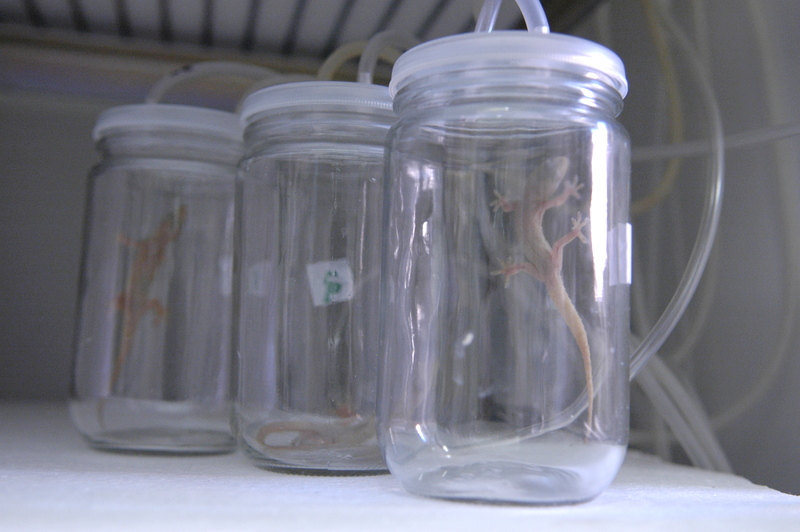
When I caught up with Rebecca, she was measuring geckos' metabolism in purpose-designed jars, which were hooked up to specialised equipment that measures oxygen consumption. Oxygen consumption is one way that scientists assess metabolic rate in animals in the lab.

collecting data on gecko metabolism

Rebecca was also video recording interactions between randomised pairs of geckos. Asian house geckos are aggressive little lizards, and will sort out dominance via displays of their open mouths, biting, and | or chasing. In her thesis, Rebecca looked at which animals were likely to be dominant, and whether that depended on their metabolism, morphology, and | or personality. 

collecting data on gecko fighting

And what did she find? The oversimplified version is that bite force, body mass, and running speed were most important in determining gecko dominance. Big, fast, hard-biting geckos were likely to be winners. The surprising thing was that metabolism and boldness didn't seem related to fighting performance.

There's a lot more to Rebecca's research: she used all the information she collected on morphology | physiology | behaviour to test important ecological theories about how individuals should interact (known as game theories). But we'll talk more about that another time - we don't want to give away everything just yet.

Thank you Rebecca, for taking the time to share your honours work with us, and for being such a wonderful labmate!

written and photographed by Amanda Niehaus, PhD